
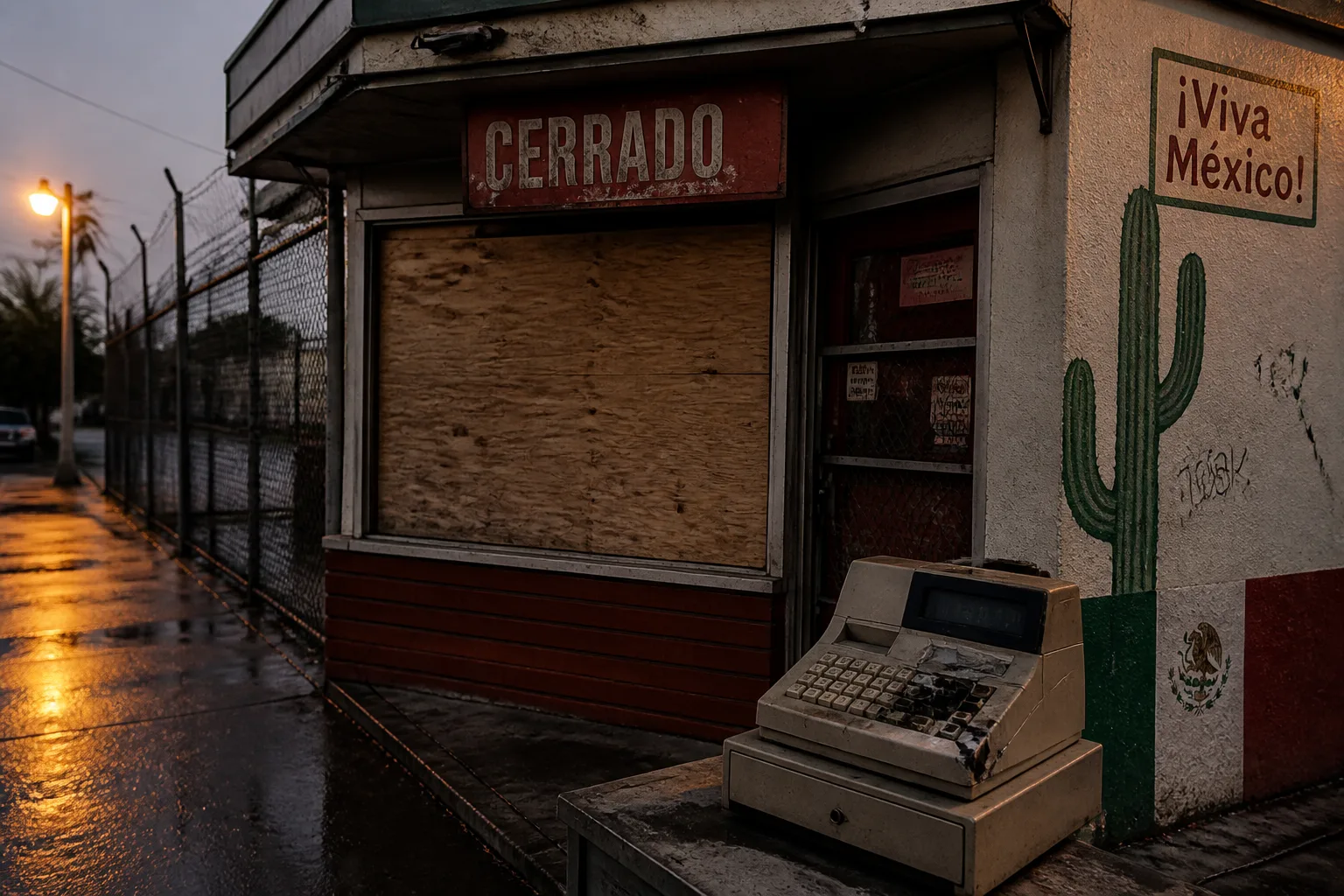
ICE Raids in Los Angeles County Triggered Immediate and Lasting Economic Shock for Latino Businesses, UCLA Study Finds
On July 22, 2026, UCLA’s Latino Policy and Politics Institute (LPPI) released a report that documents how the ICE raids that swept Los Angeles County in June 2025 triggered a steep decline in foot traffic and sales for Latino‑owned businesses—a blow that has lingered for almost a year.
Collaborating with Inclusive Action for the City and backed by the California Wellness Foundation, the Latino Community Foundation, and the Evelyn and Walter Haas, Jr. Fund, the study merged mobility data from 989 formal‑sector businesses located within a half‑mile radius of nine ICE enforcement sites with surveys and focus groups that included 75 Latino entrepreneurs spread throughout the county.
Just two weeks after the raids, the data revealed 46,000 fewer customer visits and an estimated $3.16 million in lost revenue for the affected businesses. Foot‑traffic fell 3.23 percent within a quarter‑mile of the sites and 1.63 percent between a quarter and a half mile. Eight of the nine commercial zones examined recorded a dip in foot traffic.
Extending those figures to the entire county, the authors estimate that the raids could have cost up to $52 million in just two weeks and $114 million in a month, assuming the same decline pattern continued. They caution that these numbers are illustrative rather than definitive.
Business owners faced a spectrum of financial distress. Sixty‑nine percent said revenue dropped more than half, 20 percent reported a 26‑50 percent decline, and 68 percent either temporarily shut down or cut operating hours. Fifty‑one percent of employees missed work due to fear of enforcement. Nearly a year later, 95 percent of owners still endured financial strain; 52 percent said revenue no longer covered operating costs, and 43 percent were merely breaking even.
The study also captured health repercussions. Seventy‑six percent of participants reported serious emotional distress—anxiety, depression, disrupted sleep, and hypervigilance. Others described gastrointestinal issues, panic attacks, exacerbated chronic conditions, and a need for new medications or more frequent medical visits. Researchers attribute these ailments to the economic pressure and persistent fear of enforcement.
The authors argue that the economic shock stretched far beyond the raids themselves. Loss of customers cut across sectors and formats, affecting owners regardless of immigration status. Ongoing uncertainty and financial strain eroded the capacity of entrepreneurs to sustain operations and rebound.
LPPI director Amada Armenta remarked in the accompanying statement, “Latino businesses have not recovered. These businesses function as local economic engines.” The study emphasizes that when enforcement forces customers and workers away, the damage ripples into the health, wellbeing, and safety of entire communities.
These findings come after Los Angeles County declared a state of emergency in October 2025 in response to the raid surge, empowering the county to aid residents affected by ICE activity. The report supplies a quantitative lens to the broader debate over federal immigration enforcement and its local economic and public‑health ramifications.
At this time, the study offers a snapshot of the lingering impacts of the raids. No policy changes have been announced, yet the data could guide future local and state responses to immigration enforcement.